 Satellite company SES, JioStar sign multi-year distribution deal
  MIB says no film denied screening permission at Keralam film festival
  Govt. clarifies CBFC certification changes, says 1991 core framework unchanged
  JioStar lines up power-packed festive world TV premieres
  Airtel ups value for postpaid subs; adds iCloud+ service
  Shemaroo Filmi Gaane crosses 75 million YouTube subscribers
  Why Chrome DM data matters in cross-screen media economy
  Netflix sets december 17 premiere for ‘Quiztopia’



India’s Rs. 2.78 trillion media and entertainment sector presented a mixed picture in the January-March 2026 quarter with the pay DTH subscriber base declining, while private FM radio expanded its footprint and satellite television channel availability remained broadly stable, according to data released yesterday by the Telecom Regulatory Authority of India (TRAI).
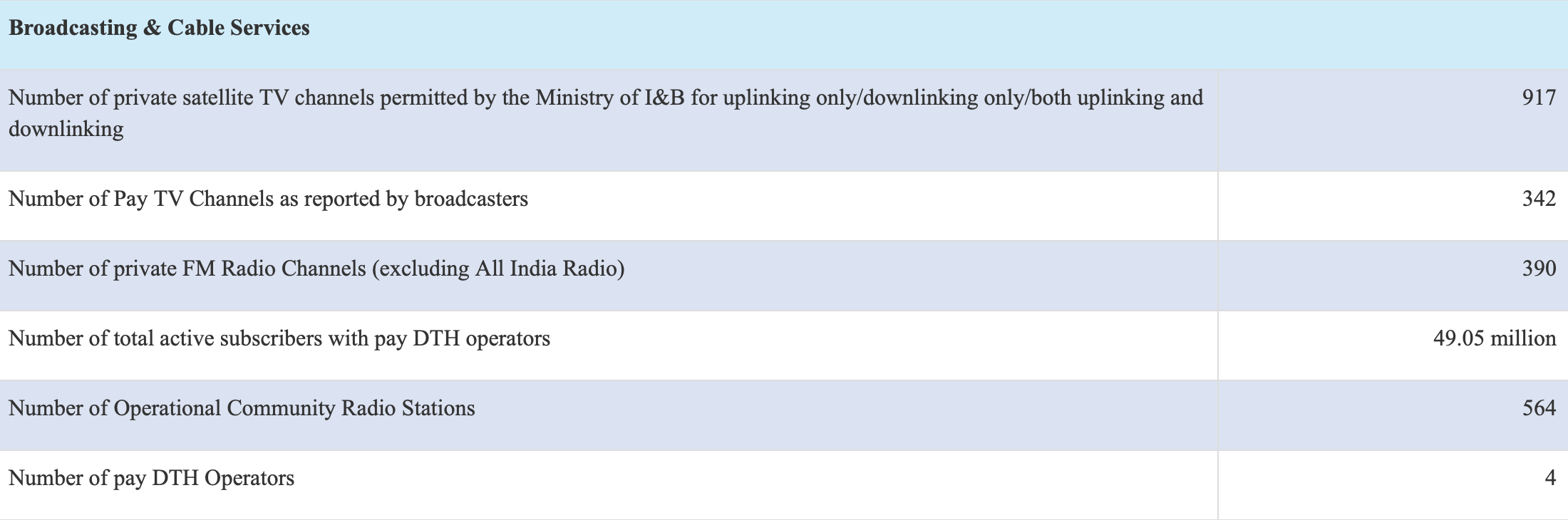
TRAI, in its ‘Indian Telecom Services Performance Indicator Report’ for the quarter January-March 2026, said 917 private satellite television channels had permission from the Ministry of Information and Broadcasting for uplinking, downlinking or both as of March 31, 2026.
Of the 908 channels available for downlinking in India, 342 were pay TV channels, comprising 238 standard-definition channels and 104 high-definition channels. The remaining 566 channels were free-to-air services.
The country had four pay DTH operators during the quarter. Their active subscriber base fell to about 49.05 million at the end of March from 50.99 million at the end of December 2025, indicating a decline of 1.94 million customers during the quarter. The figure excludes subscribers of DD FreeDish (owned and run by public broadcaster Prasar Bharati) for which TRAI did not offer any data.
In radio broadcasting, the number of operational private FM channels rose to 390 across 120 cities by March-end from 385 channels across 113 cities in the previous quarter. The increase followed the launch of seven new channels by D B Corp Ltd in seven cities, while two stations in Leh and Kargil were surrendered.
Advertising revenue reported by private FM radio operators stood at Rs 4.14 billion during the quarter under review, compared with Rs 4.19 billion in the preceding quarter, indicating a sequential decline despite the expansion in channel reach. Community radio presence continued to grow, with 564 operational stations as of March 31, 2026.
On the telecom side, India’s total telephone subscriber base increased by 24.44 million during the quarter to 1,330.58 million from 1,306.14 million at the end of December 2025, lifting overall tele-density to 93.26 percent from 91.74 percent.
Urban subscribers rose to 778.79 million, while rural subscribers increased to 551.79 million.
Wireless subscribers, including mobile and fixed wireless access (FWA) users, grew by 23.56 million to 1,282.33 million. Within this, the mobile subscriber base alone expanded by 21.53 million to 1,265.73 million during the quarter.
Wireline subscribers rose by 0.88 million to 48.25 million, registering quarterly growth of 1.86 percent.
Broadband and internet adoption recorded stronger growth. Total internet subscribers increased by 64.18 million to 1,092.79 million, while broadband subscribers rose by 58.53 million to 1,065.88 million.
Wired internet subscribers stood at 46.54 million and wireless internet subscribers at 1,046.26 million.
The telecom services sector reported gross revenue of about Rs 1.05 trillion, adjusted gross revenue of Rs 867.16 billion and wireless average revenue per user of Rs 196.04 per month during the quarter, according to TRAI data.