 MIB seeks dismissal of AIDCF plea against WAVES, says OTT rules differ from TV
  Uday Shankar: Indian M&E sector needs policy support to compete globally
  Guest Column: STB evolves from decoder to connected entertainment
  Meta says expanded AI sweep of ads linked to child abuse in India
  With WBD merger closed, Skydance is a Hollywood giant
  CNN-News18 leads YouTube viewership, outpaces Times Now, India Today
  Hansal Mehta’s untitled series begins filming
  Ansh Duggal-starrer ‘Nakhrewaalii’ to release in theatres on Oct 30
  Sunny Deol’s ‘Suryaa’ to release on Nov 20, motion poster unveiled
 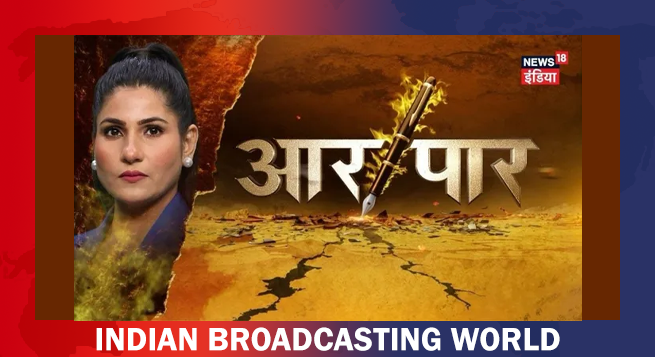 Rubika Liyaquat to host News18 India’s ‘Aar Paar’ from October 12



The Ministry of Information and Broadcasting (MIB) has asked the Telecom Disputes Settlement and Appellate Tribunal (TDSAT) to dismiss a petition filed by the All India Digital Cable Federation (AIDCF) challenging Prasar Bharati’s move to onboard linear television channels on its WAVES streaming platform. The ministry has argued that the rules governing satellite television distribution do not apply to over-the-top (OTT) platforms.
The dispute centres on whether internet-based streaming services such as WAVES should be subject to the same regulatory framework as traditional television distribution platforms, including cable and direct-to-home (DTH) operators.
According to a Storyboard18 report, the MIB has challenged the maintainability of AIDCF’s petition and argued that it has been unnecessarily impleaded in the proceedings. The ministry has maintained that OTT services do not fall within the domain of broadcasting as defined under the existing satellite television guidelines and that the tribunal’s jurisdiction to hear the matter is also in question.
AIDCF, which represents multi-system operators (MSOs), has challenged Prasar Bharati’s notice inviting applications (NIA) for onboarding linear satellite television channels on WAVES. The federation contends that the initiative conflicts with the existing regulatory framework governing broadcasting and television distribution.
At the centre of the dispute is Clause 11(3)(f) of the Uplinking and Downlinking Guidelines for Satellite TV Channels in India, 2022. AIDCF argues that broadcasters are required to provide signal reception decoders to recognised distribution platform operators, including MSOs, DTH operators, headend-in-the-sky (HITS) operators and internet protocol television (IPTV) platforms.
The federation maintains that OTT platforms do not fall within these recognised categories and, therefore, cannot be treated as eligible recipients of such decoders. It has asked TDSAT to set aside the notice issued by Prasar Bharati and restrain the public broadcaster from proceeding with the onboarding exercise.
The MIB has rejected this interpretation, arguing that satellite television guidelines are designed for services involving the uplinking and downlinking of satellite television signals, rather than content delivered through internet-based streaming.
“The Uplinking and Downlinking Guidelines and the TRAI Regulations do not apply to OTT platforms and services and OTT services do not fall within the domain of broadcasting. An OTT service is not a broadcasting service,” the ministry stated in its reply.
The ministry has also questioned whether the dispute falls within TDSAT’s jurisdiction under Section 14(a)(ii) of the Telecom Regulatory Authority of India Act, 1997. According to the MIB, the case does not involve a licensor-licensee relationship or a dispute between service providers covered by the provision.
It has further argued that OTT platforms do not operate under permissions or licences granted by the ministry and cannot, therefore, be classified as distribution platforms or distribution platform operators under the existing regulatory framework.
The MIB has said that Prasar Bharati’s notices relate to sourcing content for WAVES, with the material being received and made available through internet protocol-based networks. On this basis, it maintains that the satellite television uplinking and downlinking guidelines are not applicable to the initiative.
The ministry has also disputed AIDCF’s reliance on the term “linear satellite channel”, arguing that its use in the context of OTT platforms is generic and does not mean the content is being distributed as a linear satellite television channel under the Cable Television Networks Rules, 1994.
To support its position, the MIB has referred to the explanatory memorandum accompanying the Telecom Regulatory Authority of India’s (TRAI) 2017 tariff order. The memorandum stated that the framework applied to distribution platforms and operators for which the ministry granted permission or a licence. According to the MIB, OTT operators and Doordarshan were not covered by such permissions or licences and consequently fell outside the scope of that particular regulatory framework.
The ministry has also cited a TDSAT order dated October 4, 2023, in All India Digital Cable Federation vs Star India Private Limited, Broadcasting Petition No. 217 of 2023. In that matter, the tribunal had observed that an OTT platform was prima facie not a television channel and that the respondent did not require permission or a licence from the Central government to operate the platform.
The MIB has further argued that OTT services are governed by the Information Technology Act and the Information Technology (Intermediary Guidelines and Digital Media Ethics Code) Rules, 2021. It has said there is no requirement for a separate licensing and regulatory framework for broadcasting content over OTT platforms or for restricting its dissemination in the manner sought by AIDCF.
The case raises broader questions about regulatory parity between traditional television distributors and digital platforms. Cable and DTH operators function within an established licensing and compliance framework, while OTT platforms operate under a different regulatory regime.
AIDCF argues that allowing broadcasters to distribute linear channels through WAVES without comparable obligations could create an uneven playing field for traditional distribution operators. The federation has also contended that broadcasters could risk violating conditions attached to their downlinking permissions if signal reception decoders are provided to an OTT platform that does not qualify as a recognised distribution operator.
Prasar Bharati’s initiative seeks to expand the reach of television content through digital distribution, reflecting the growing overlap between conventional broadcasting and streaming services. The MIB, however, maintains that the mode of delivery is central to determining which regulatory provisions apply, and that content streamed over the internet should not automatically be governed by rules designed for satellite television distribution.
The ministry has asked TDSAT to reject the reliefs sought against it. The tribunal’s decision on the petition’s maintainability and the applicability of the relevant regulatory provisions could have implications for broadcasters, cable operators and digital distribution platforms as they compete for audiences across different delivery networks.