 Sunil Mittal says OneWeb ahead of Musk in Indian approval queue
  Murugan resigns from Cabinet as Mos MIB & Rajya Sabha
  Broadcasters flag HD-SD conversion, satellite spectrum concerns in submission to MIB on telecom rules 2026
  MIB seeks dismissal of AIDCF plea against WAVES, says OTT rules differ from TV
  Uday Shankar: Indian M&E sector needs policy support to compete globally
  ‘The Love Hypothesis’, ‘Carrie’ lead Prime Video’s weekly global rankings
  Amitabh Bachchan recalls Allahabad’s famous milk jalebis on ‘KBC 18’
  Prime Video announces weekly line-up of Indian, global shows & series
  Harshdeep Kaur to open TV9 Festival of India 2026 Oct 16
 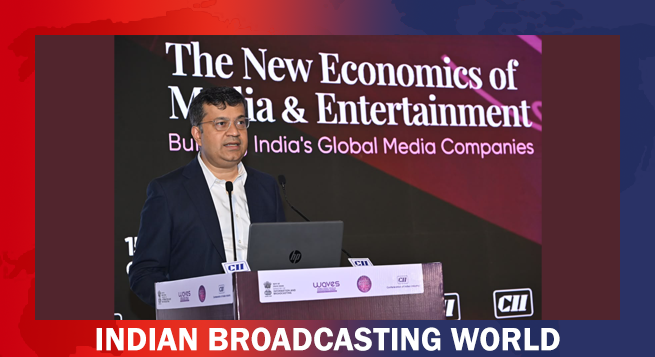 Indian M&E industry needs fundamental business model rewrite: Gaurav Banerjee



India’s Media and Entertainment (M&E) industry needs to fundamentally rethink its business models to convert its vast audience reach and creative strengths into sustainable economic value, said Gaurav Banerjee, Chairman of the CII Media and Entertainment Committee and MD and CEO of Sony Pictures Networks India (SPNI).
Speaking at the inaugural session of the CII Big Picture Summit in Mumbai, today, Banerjee said the summit’s theme, “The New Economics of Media & Entertainment”, highlighted the urgent need to build an industry that delivers greater value to audiences, creators, advertisers and investors.
“Today, more than at any other time in the past, economic and business models are under stress. They require a fundamental rewrite,” Banerjee said. “A large audience is, finally, just a starting point. It is not a business model.”
He stressed that audience reach alone does not guarantee sustainable business performance. Instead, media companies must focus on the value they create. Audiences expect entertainment worth their time and money, advertisers need credible evidence of business outcomes, and investors want confidence that creative ambition can translate into sustainable, long-term returns.
Building a stronger talent development system
Banerjee called for a more structured approach to discovering and developing creative talent, drawing a comparison with the Indian Premier League’s talent scouting and coaching system.
He urged industry stakeholders to develop similar pathways for Indian storytellers, enabling talent discovery, skill development and wider access to opportunities.
“What would it take to do that for our entertainment storytellers? How can this forum, CII, policymakers and companies like ours make that process bigger, better, more systematic and better organised?” he said.
According to Banerjee, building a stronger creative ecosystem will require coordinated efforts from industry bodies, policymakers, media companies and educational institutions.
Indian IP needs long-term investment
Banerjee also called for a fundamental shift in how media businesses invest in and monetise intellectual property (IP). While Indian programmes, films, characters and formats have become part of the country’s cultural memory, he said the industry must examine whether it is capturing their full economic potential.
He advocated building enduring franchises that can span decades, cross language barriers and reach international markets. Such properties should be developed across television, streaming, cinema, live experiences and licensing.
Achieving this, he said, will require stronger development processes, research-led writers’ rooms and partnerships that help Indian IP reach new audiences. At the same time, creators must receive fair rewards for their work, with their rights respected.
Measurement and monetisation must evolve
As audiences increasingly move between screens and platforms, Banerjee said measurement and monetisation systems must keep pace with changing viewing habits.
He called for a more coherent understanding of audience reach, engagement and business outcomes, noting that greater collaboration across the industry could help advertisers make better-informed decisions and build confidence in their investments.
The broader challenge, he indicated, is to move beyond headline audience numbers towards demonstrating the tangible value delivered by media and entertainment businesses.
AI must support creativity, not replace creators
Addressing artificial intelligence, Banerjee urged the industry to look beyond production efficiencies and explore how AI can strengthen research, development and creative discovery.
He cautioned against using the technology solely as a cost-cutting tool, emphasising that it must preserve the creative voice and contribution of storytellers.
“My concern is that AI should not be used simply to reduce costs thoughtlessly. It must never be used to replace the voice of the creator,” Banerjee said. “It should be an enabling function, not a replacement function.”
His remarks underscored the need for responsible AI adoption that supports creative professionals while enabling the industry to innovate and operate more effectively.
Three priorities for Industry-Wide sction
Banerjee outlined three priorities for collective action through the Confederation of Indian Industry (CII). These include developing a forward-looking framework for intellectual property and responsible AI, strengthening talent and skills development through partnerships with educators, technology companies and creative businesses, and engaging constructively with the government to establish a predictable environment for long-term investment and global competitiveness.
He said these measures would be essential to building a more resilient industry capable of delivering lasting economic value.
“Our opportunity is not simply to serve a large domestic audience. It is to build businesses, franchises, capabilities and talent in India that can create value around the world,” Banerjee said.
His address at the CII Big Picture Summit placed sustainable business economics, stronger Indian IP, systematic talent development and responsible AI adoption at the centre of the industry’s future growth agenda.