 Google brings AI Mode ads to India, 9 other markets
 Of Jio listing, tears, party…and RIL’s combined $320bn market cap
 Guest Column: TRAI’s ALTD reccos a turning point for b’cast sector
 Indian publishers, including those owned by Ambani & Adani, challenge privacy laws
 Netflix’s marks Korean decade as K-content rules non-English viewing
 JioStar Q2 revenue up 10.1% to Rs 6,806cr. despite weak ad environ
 TRAI proposes stricter AI governance norms for telecom operators
 Bhushan Kumar, Rishab Shetty join hands for 2-part Shivaji biopic
 Prime Video sets Nov. slate with Muhammad Ali series, ‘Rings of Power’
 Indian Football League 2026-27 season airing on Zee, Prasar Bharati




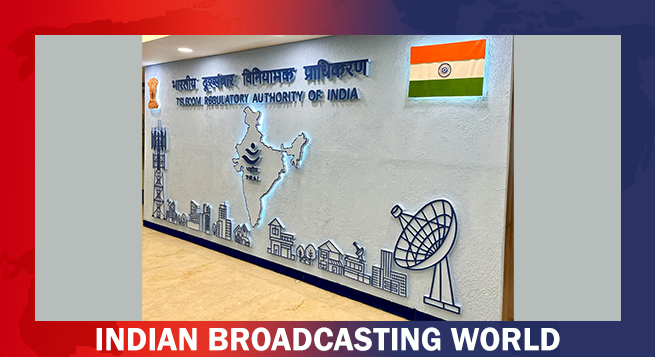
TRAI yesterday proposed a comprehensive draft framework for the responsible use of artificial intelligence in telecom networks that would require service providers to adopt board-approved AI policies, establish dedicated governance and safety committees, and report serious AI-related incidents to the regulator.
The draft guidelines, released for stakeholder consultations, also seek to make entities accountable for the outcomes of AI systems deployed in their networks and services, “irrespective of whether AI systems are developed internally, procured/ outsourced from a third party or a combination thereof,” a PTI report from New Delhi yesterday stated.
The Telecom Regulatory Authority of India (TRAI), in a release, said it has floated the “draft ‘Guidelines on Responsible Use of Artificial Intelligence in Telecommunication Networks and Provision of Telecommunication Services’ for stakeholders’ comments”.
TRAI has proposed a comprehensive draft framework for the responsible use of artificial intelligence in telecom networks that would require service providers to adopt board-approved AI policies, establish dedicated governance and safety committees, and report serious AI-related incidents to the regulator.
A look at the consultation paper shows that under the proposed framework, telecom operators and other authorised entities using AI will have to classify their AI systems into high-, medium- and low-risk categories based on their significance to network operations, financial and operational outcomes, and potential implications for consumers.
Each entity will be required to formulate an internal AI policy, approved by its board of directors or equivalent governing body, covering risk classification, deployment approvals, incident management, human oversight, data governance and consumer grievance redressal.
“All AI systems shall be subject to an appropriate human oversight for risk mitigation as per a predefined mechanism,” the consultation paper said.
The regulator has proposed that AI-related incidents be classified into four categories, namely critical, high, moderate and low severity, with critical and high-severity incidents mandatorily reported to TRAI.
“Critical severity AI incidents and high severity AI incidents shall be informed to TRAI in a prescribed format, manner and timeframe,” it said.
Telecom companies will also have to maintain central databases of AI incidents and consumer complaints involving AI-related harm, with mechanisms for investigation, mitigation and resolution.
The sector regulator noted that, at present, AI is increasingly being integrated into telecommunication networks and provision of telecommunication services.