 Netflix, hoichoi in pact to take Bengali stories to wider audiences
  JioHotstar to offer ‘Ramayana’ on pay-per-view after theatrical run
  MIB issues advisory for TV channels on news reporting, AI use
  Netflix to expand ads plan to 15 new countries in 2027
  News18, TaMo to mark Oct 23 as ‘National Saarthi Diwas’
  Airtel launches voice-only prepaid plans starting at Rs 185
  ‘Crazy Rich Asians’ series to begin filming in 2027, says Constance Wu
  Shanaya Kapoor’s ‘Student of the Year: After Dark’ set for Nov 13
  ‘The Odyssey’ to arrive on Prime Video on Nov 17
  Meta adds new AI tools for forum admins
  Prabhas’ ‘Fauzi’ teaser released on 47th birthday



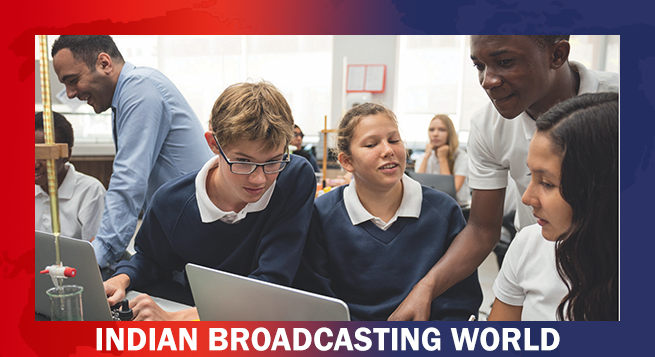
Teenagers more accustomed to smartphones than Shakespeare are reading at the worst levels seen this century, driving a broader decline in education, a global student assessment found.
According to a Reuters report from Paris yesterday, the Organisation for Economic Co-operation and Development’s (OECD) 2025 test of 760,000 15-year-olds across 91 countries showed reading, mathematics and science scores at their lowest levels since data began to be collected in 2000.
On average, students were reading at a level that had in the past been expected of students one year younger, according to the OECD’s latest Programme for International Student Assessment released yesterday.
A 2012 reading high of 501 on PISA’s index had declined to a score of 466 last year. The test is widely regarded as the world’s leading gauge of educational performance and its results are closely scrutinised by governments and educators.
“In reading, more screen time and less reading for pleasure have gone hand in hand with weaker results,” OECD head Mathias Cormann told a press conference.
“We’re also seeing more hasty reading, students rushing through a text and giving a quick wrong answer,” he added.
Reading scores fell more sharply in students from better-off backgrounds, the study added.
Hindered by falling reading standards, average teenage science and maths skills were also at their lowest this century. Science fell from a 2009 high of 506 on the index to 486, while maths was down from 502 to 469 in the same period.
East Asia was the best-performing region. Chinese cities that participated in the test, Japan, Korea, Singapore and Taiwan had the best educational systems with Britain and Estonia the only countries outside the region that made it into the top 10 in reading, mathematics and science.
The report stopped short of endorsing smartphone bans in schools. But it said that digital distraction is linked to lower science scores in 59 of 82 education systems studied and more than one in four students say devices distract classmates in science lessons.
The OECD said students reported spending 3.4 hours per weekday for leisure on digital devices on average in OECD member countries and another 3 hours per weekday in the classroom and at home for learning purposes.
Digital devices could be used to improve learning, but only up to a point, Cormann said. If used more than five hours a day, results started to fall, he added.
The study also found that nearly half of students use artificial intelligence chatbots regularly for learning, but those who use them for drafting essays, summarizing texts and researching topics generally score about 20 points lower in science, equivalent to a year’s learning. (Image courtesy OECD report)