 Prasar Bharati holds copyright over content, govt clarifies in Parliament
  ‘One Battle…’, ‘Sinners’, Marty…’, begin Mar15 Oscars quest
  Govt admits ad code bars ‘miraculous’ claims in product ads
 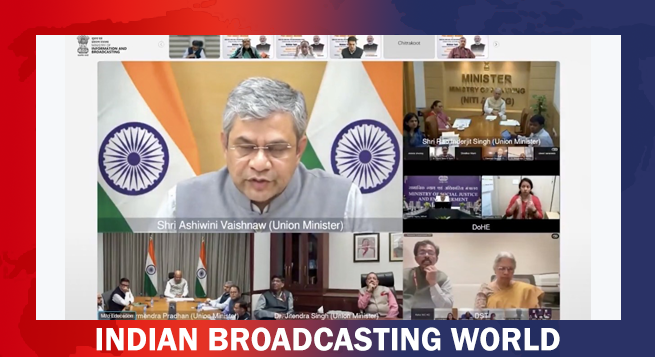 Vaishnaw: Creator economy offers citizens a democratic platform
  Prime Video, HBO Max executives to headline Series Mania Forum
  NDTV’s Creators Manch S2 to be held in Delhi on March 14–15
  ‘Raftaar’ set for theatrical release on July 24
  India Today Conclave returns to Delhi for 23rd edition on Mar 13-14
  ‘Cocktail 2’ set for theatrical release on June 19



The telecom department’s highest decision-making body yesterday sought clarification from telecom regulator TRAI on certain aspects of satellite spectrum recommendations, sources said indicating that fee mooted for urban customers and the annual minimum spectrum charges suggested by the regulator could be some of the areas for the back-reference.
The development assumes significance as prominent companies including billionaire Elon Musk-owned Starlink, Bharti-backed Eutelsat OneWeb, and Reliance Jio-SES, are keenly eyeing the high stakes game of broadband beamed from Indian skies.
According to a PTI report from New Delhi yesterday, the Digital Communications Commission (DCC) held a meeting yesterday to discuss the recommendations of the Telecom Regulatory Authority of India (TRAI) on satcom spectrum. Sources said the multi-ministry apex decision-making body that looks at significant telecom matters, has decided to seek certain clarifications from TRAI over satcom spectrum recommendations.
Areas where clarification are likely to be sought include the regulator’s suggestion on charging additional Rs 500 per annum from urban areas, sources said adding that Telecom Department is of the view that implementation challenges and issues around billing could arise. Further they feel a clear rural-urban demarcation may be difficult.
Another aspect where DoT may seek clarification pertains to TRAI’s recommendations of Rs 3,500 per MHz annual minimum spectrum charges for GSO/NGSO-based fixed satellite services and GSO/NGSO-based mobile satellite services.
Sources said given that spectrum is a valuable resource, the amount of Rs 3,500 per MHz is less, and would not be an effective safeguard against someone holding and not using spectrum. DoT believes that the annual minimum spectrum charges should be pegged higher to ensure spectrum doesn’t remain utilised.
In May this year, the telecom regulator had released its recommendations on pricing of spectrum for satellite-based internet services, suggesting a levy of 4 per cent of annual revenues as fee on operators like Elon Musk’s Starlink.
Operators offering services in urban areas would have to shell out an additional Rs 500 per subscriber annually, while no additional levy would be applicable for services in rural areas, TRAI had said.
The regulator had recommended that satellite broadband spectrum be allotted for five years, which can be extended by another two years. The 4 percent of adjusted gross revenue (AGR) spectrum charge would be for both geostationary orbit (GSO) and NGSO (non-Geostationary orbit) operators. These would be subject to a minimum annual spectrum charge of Rs 3,500 per MHz.
SpaceX, the aerospace company led by the world’s richest man Elon Musk, has already tied up with rivals Reliance Jio and Bharti Aitel to bring Starlink’s broadband internet services to India. Both Indian firms will offer Starlink equipment through their network and also support customer installation and activation on devices.
Separately, Eutelsat OneWeb and Jio Satellite Communications have also received licence from the Department of Telecommunications to provide satellite internet services in the country. Amazon’s Kuiper is awaiting DoT’s nod, pending some compliance.