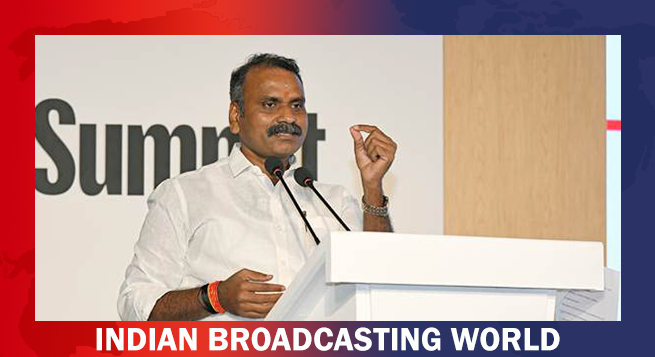
 Murugan resigns from Cabinet as Mos MIB & Rajya Sabha
  Broadcasters flag HD-SD conversion, satellite spectrum concerns in submission to MIB on telecom rules 2026
  MIB seeks dismissal of AIDCF plea against WAVES, says OTT rules differ from TV
 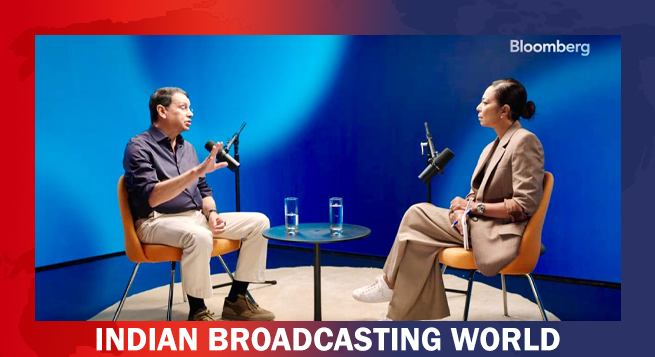 Uday Shankar: Indian M&E sector needs policy support to compete globally
  Guest Column: STB evolves from decoder to connected entertainment
  ‘Khosla Ka Ghosla 2’ to release on March 5
  Apple TV unveils trailer for ‘12 12 12’ heist drama
  Netflix secures FIFA World Cup 2030 rights in Spain and Andorra
  ‘Ishqa Ishqa’ part 2 promo out
  ‘Rise and Fall’ S2: Swara Bhasker, Niharika Tiwari battle for ultimate ruler crown



India’s economic momentum showed early signs of moderation in March, with Moneycontrol’s Advance Business Index (ABI) easing to 102.4 from February’s peak of 103.5, even as overall activity remained above its long-term trend. The dip reflects the first visible impact of rising geopolitical tensions and energy-related disruptions, though domestic demand continues to lend support.
According to a press release from the news website, it highlights the slowdown is modest, it signals a transition phase for the economy amid evolving global uncertainties. The ABI, launched by Moneycontrol on April 10, is a high-frequency indicator designed to track early signals of economic activity, where a reading above 100 indicates above-trend growth.
The March reading suggests that India’s growth engine is still running steadily, but cracks are beginning to appear under external pressure. The ongoing conflict in the Middle East has pushed up energy prices and disrupted supplies globally. In India, this has been compounded by constraints in natural gas availability for certain industrial users, adding pressure on manufacturing and production cycles.
Early signs of this stress are now visible across key industrial indicators. Manufacturing activity softened, with HSBC’s PMI data showing a drop to a four-year low as input costs surged. Logistics demand and other proxies tied to industrial output also reflected a gradual cooling, pointing to the cascading impact of energy disruptions on production and supply chains.
Despite these challenges, the broader economy has held up relatively well. Consumption-led indicators continue to show resilience, helping cushion the external shocks. Auto sales remained strong, with four-wheeler sales rising 22.9 percent year-on-year and two-wheeler sales jumping 29 percent in March. Fuel consumption trends were also positive, with diesel usage and coal offtake registering increases, signalling sustained activity in certain sectors.
However, the labour market showed some weakness. Job creation slowed during the month, with sectors such as trade reporting a decline, as reflected in the Naukri Jobspeak Index. At the same time, financial activity remained stable, with non-food credit growth picking up pace compared to February, indicating continued lending momentum.
The overall trajectory of the ABI suggests that India’s economy is moving from a phase of strong acceleration to a more stable, moderated growth cycle. While the index remains higher than its level a year ago, the pace of expansion is no longer as sharp, pointing to a phase of consolidation.
For the January-March quarter, the average ABI reading indicates that growth remains robust, albeit slightly softer than in previous quarters. The data underscores a balancing act—while global energy shocks and supply-side constraints are beginning to weigh on growth, strong domestic demand continues to act as a buffer.