 WAVES Film Bazaar to mark 20th edition alongside 57th IFFI in Goa
 JioStar completes two years, JioHotstar achieves major digital milestones
 Is Meta’s pausing of terms’ updates good for news outfits?
 ‘Ramayana’ opens to mostly favourable reactions from moviegoers
 Ofcom demands tougher action against online child exploitation
 Akshay Kumar’s ‘Samuk’ first look unveiled, film to release May ’27
 Rohit shares memorable cricket moments on ‘Family Full House’
 Bengaluru Comic Con 2027 to return on Feb 13-14
 57th IFFI to screen 230+ films; Russia partner nation; focus on accessibility




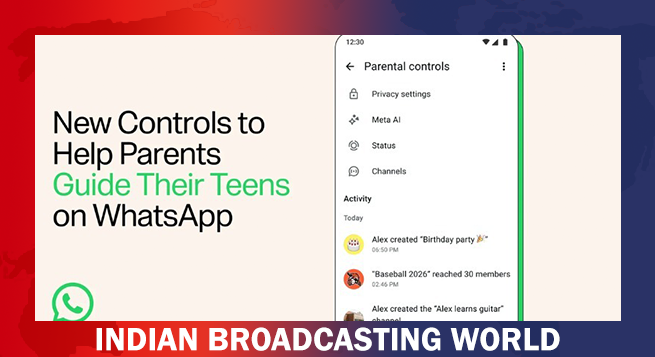
WhatsApp has introduced a new set of parental controls for teen accounts, giving parents greater oversight of how their children use the messaging platform while keeping their private messages protected.
The new controls allow parents to decide who can see a teen’s profile photo, who can add them to groups, how they use Channels and whose Status updates they can view.
Parents can also control who is able to view their teen’s Status updates.
The update, announced by WhatsApp, also gives parents notifications about certain changes in their teen’s group activity.
Parents will be notified when a teen joins or leaves a group, as well as when the number of members in a group crosses thresholds of 30, 100 or 250 members.
The parental controls are protected by a parent-set PIN, meaning a teen will need approval before changing or loosening any of the restrictions. Parents can also choose to disable the controls entirely.
The new features also extend to Meta AI, giving parents the option of keeping the platform’s default 13+ content setting or switching to a stricter ‘Limited Content’ mode. The latter disables features such as incognito chat and message summaries.
WhatsApp said the new controls do not change the privacy of conversations on the platform.
Messages and calls continue to be protected by end-to-end encryption, meaning their content cannot be accessed by WhatsApp or other third parties.
The update is part of Meta’s wider efforts to introduce additional safety measures for younger users across its platforms.