 ‘Punha Ekda…’ to stream on Ultra Jhakaas from Mar 19
  Punjab unveils film promotion policy offering major subsidies
  Prasar Bharati holds copyright over content, govt clarifies in Parliament
  ‘One Battle…’, ‘Sinners’, Marty…’, begin Mar15 Oscars quest
  Govt admits ad code bars ‘miraculous’ claims in product ads
  Choice International, CNBC-AWAAZ host ‘Nivesh Nirnay’ initiative in Vadodara
  WION to host World PULSE forum in New Delhi
  Sanjay Kapoor reflects on working with Prakash Jha in ‘Sankalp’
  Disney reshapes entertainment leadership under Dana Walden
  Prime Video, Hrithik Roshan team up again for comedy ‘Mess’



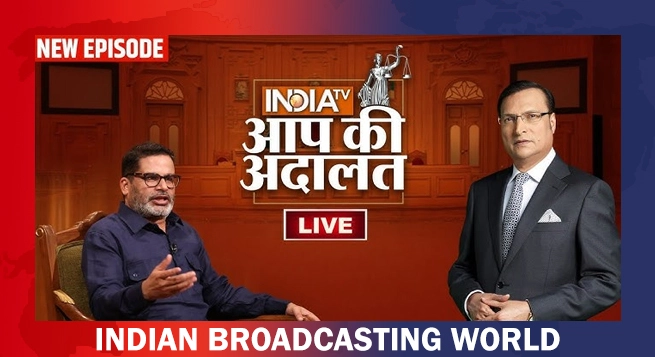
In a candid interview on the popular television show ‘Aap Ki Adalat‘, election strategist and Jan Suraaj Party Coordinator Prashant Kishor shared his views on the political landscape and the stability of Prime Minister Narendra Modi’s government.
Kishor stated that the upcoming assembly elections in nine states over the next year will play a crucial role in determining the future stability of the NDA government, the news channel stated in a press release.
Speaking to Rajat Sharma, Kishor emphasized that the outcomes in Jammu & Kashmir, Delhi, Haryana, Maharashtra, Jharkhand, Bihar, West Bengal, Tamil Nadu, and Assam could challenge the current government’s stability. “If the BJP loses in five or six of these nine states, stability will become a significant issue,” Kishor explained.
Reflecting on the 2024 Lok Sabha results, Kishor described the outcome as “a good one” but suggested that the electorate had sent a nuanced message to PM Modi. He said, “People have asked Modi to govern like a democratic leader, not as a dictator.” Kishor acknowledged that the results indicated support for the BJP but with reservations, cautioning Modi to govern carefully.
Kishor commented on Congress leader Rahul Gandhi’s performance, recognizing his progress but noting he has “miles to go” to establish himself as a national leader. He credited Gandhi for the Congress’s unexpected performance, winning 99 seats, but contrasted this with the need to win “250 to 260 seats” to emerge as a formidable alternative.
Kishor, who plans to launch his Jan Suraaj Party in Bihar on October 2, underscored the potential for new political alternatives in the current environment. He pointed out that despite BJP’s dominance, the opposition continues to strengthen, particularly among the underprivileged, who are not swayed by high-profile marketing campaigns.
Kishor admitted that his prediction of BJP winning 300 seats in the 2024 elections was incorrect, citing factors such as rural distress, farmers’ problems, and growing inequality. He also observed a shift in the political axis from the Congress to the BJP, similar to the period from 1950 to 1990 when Congress was the political center.
Addressing the supposed rivalry between Uttar Pradesh Chief Minister Yogi Adityanath and Home Minister Amit Shah, Kishor dismissed it as mere speculation. He suggested that internal dynamics within the BJP may have influenced the electoral outcome in Uttar Pradesh.
Kishor concluded that the opposition appears more cohesive, which is beneficial for democracy. He forecasted that the BJP will remain a key political force in India for the next 25-30 years, regardless of future electoral outcomes. “The opposition’s efforts to set their narrative in a coordinated manner should be applauded,” he added.