 IBDF-led multi-body coalition bats for consent-led AI copyright rules
  JioStar VC Uday Shankar to deliver keynote at New Delhi AI Summit
 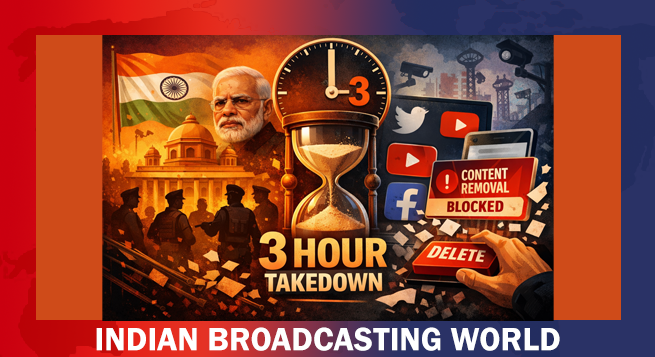 Govt. issues stringent 3-hour content takedown rule for SM firms
  Guest Column: Budget’s policy interventions to boost Orange Economy
  Saurav Maheshwari joins NDTV as regional CTV Revenue Head
  JioHotstar announces Barjatya’s ‘Sangamarmar’ series
  ESPN takes over MLB.tv, expands teams’ in-market streaming
 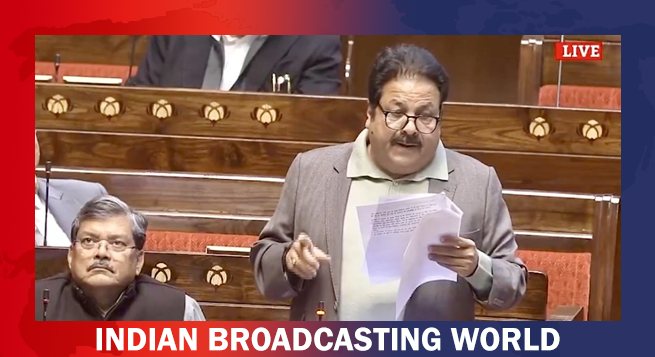 Congress MP Shukla joins clamour for digital content, AI monitoring


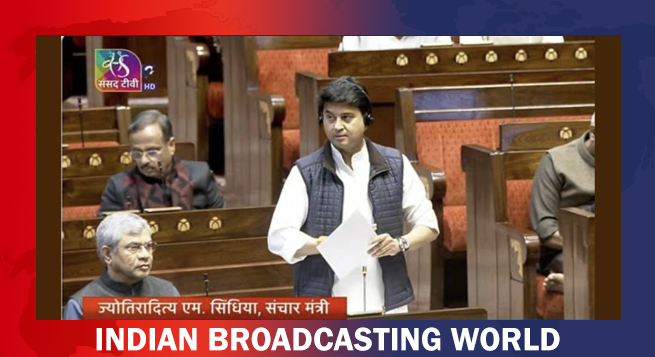
Union Communications Minister Jyotiraditya Scindia yesterday informed Parliament that BharatNet has connected nearly 2.14 lakh gram panchayats (village administrations) across the country and played a transformative role in expanding broadband access in rural India, as he outlined the government’s progress under the National Broadband Mission (NBM) 2.0 with clear targets set for 2030, including hi-speed Internet connections.
Replying to a question in the Rajya Sabha, a government statement yesterday quoted Scindia as saying that BharatNet, one of the world’s largest government-led connectivity programmes, aims to provide internet connectivity to every citizen.
He said mobile subscribers have risen from 930 million in 2014 to 1.2 billion at present, with penetration increasing from 75 per cent to 92 per cent. Internet subscribers have grown from 250 million to over 1 billion, while broadband subscribers have increased from 61 million to more than 1 billion. The national average fixed broadband download speed now stands at 61.55 Mbps, he added.
Under BharatNet Phases I and II, optical fibre cable has been laid to connect gram panchayats at an approximate cost of Rs. 42,000 crore. Of the 2.56 lakh gram panchayats in the country, nearly 2.14 lakh have been made online. In Tamil Nadu, which is implementing the project through its special purpose vehicle Tanfinet, 10,869 of 12,525 gram panchayats have been connected. The remaining gram panchayats and 4,767 non-gram panchayat villages will be covered under the Amended BharatNet Programme, a $16.9 billion initiative, the statement quoted the Minister as saying.
Detailing National Broadband Mission 2.0, launched on April 1, 2025, the Minister said it has set seven targets for 2030, including OFC connectivity with 95 per cent uptime in 2.7 lakh villages, 90 per cent broadband connectivity to anchor institutions such as schools and anganwadis and raising average fixed broadband speed to 100 Mbps.
Scindia said 42,000 villages currently have OFC connectivity with 95 percent uptime, while broadband connectivity to anchor institutions stands at 68.8 per cent. The average Right of Way (RoW) application disposal time has been reduced from 455 days to 30.4 days, achieving the 2030 target ahead of schedule.
Scindia called for greater cooperation from States in implementing the Telecommunications Right of Way Rules, 2024, noting that 33 of 36 States and Union Territories have adopted them.
Satellite Broadband: Meanwhile, Minister of State for Communications Dr. Pemmasani Chandra Sekhar informed Rajya Sabha yesterday that the Department of Telecommunications has granted Unified Licence with GMPCS authorisation to OneWeb India Communications Pvt Ltd, Jio Satellite Communications Ltd and Starlink Satellite Communications Pvt Ltd to provide satellite-based internet services.
He said satellite communications would help extend connectivity to rural, remote and underserved areas that are difficult to cover through terrestrial networks, thereby supporting efforts to bridge the digital divide.