 Netflix’s marks Korean decade as K-content rules non-English viewing
  GTPL Hathway now tracking TV viewership via RPD, targets 50k homes
  Netflix, hoichoi in pact to take Bengali stories to wider audiences
  JioHotstar to offer ‘Ramayana’ on pay-per-view after theatrical run
  MIB issues advisory for TV channels on news reporting, AI use
  NDTV Profit to host Diwali investment event in Mumbai
 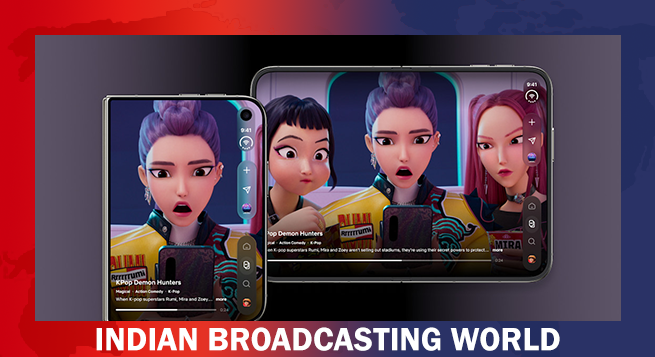 Netflix revamps mobile experience; starts with Apple’s iPhone Duo
  Netflix sets family drama ‘Dilwali Diwali’ release for Nov 5
  Is Diljit Dosanjh appearing on ‘Koffee With Karan’ S9?
  TRAI proposes new rules for Internet-based TV services




A new PwC report yesterday said that growing use of artificial intelligence in advertising, among other factors, is expected to fuel global media and entertainment (M&E) industry’s revenues to US$ 3.5 trillion at a compound annual growth rate of 3.7 percent .
The fastest growing markets globally continue to be in developing markets, including India and Indonesia — all with CAGRs above 7.5 percent, added PwC’s Global Entertainment & Media Outlook 2025-29 report released yesterday.
“In India, much of the growth will stem from internet advertising — which is growing at a CAGR of 15.9 percent — driven by expanding internet penetration, rising 5G connectivity, and the popularity of social media and short-form video content,” the PwC report asserted.
Pointing out that the global MEE’s growth will also be supported by non-digital categories such as live events, a media statement from PwC said the CAGR of 3.7 percent until 2029 is a rate above the projected global economic growth average, but below pre-pandemic highs.
“Economic uncertainty and anaemic consumer spending growth, amid heightened domestic and international competition in the industry, is expected to weigh on E&M growth rates through the forecast period until 2029,” a media statement on the report issued by PwC explained.
Bart Spiegel, Global Entertainment and Media Leader, PwC US, said in a statement: “As the E&M (also referred to as M&E) industry continues to be impacted by broader economic uncertainty and constrained consumer spending, advertising is emerging as the leading powerhouse of the global entertainment and media industry’s revenues – a transformation expected to continue as AI transforms delivery models, democratises content production, serves highly curated content experiences, and reduces barriers to entry.
“The E&M industry has always been at the forefront of technological innovation, but companies will need to remain nimble and proactive to embrace the future and satisfy consumers in an ecosystem that rewards creativity and tailored content.”
AI& Advertising: Advertising to serve as industry engine for revenue growth as AI transforms advertising models, the report projected.
As growth for paid or subscription products slows amid heightened industry competition and constrained consumer spending, particularly in mature markets, advertising is forecast to represent a significant driver of revenue growth for the M&E industry at-large.
Of the three major M&E categories analysed (connectivity, advertising, consumer), advertising is expected to grow fastest — three times as fast (6.1 percent CAGR) as the consumer category (2 percent).
The fastest growing M&E revenue metrics over the next five years are all advertising driven, including retail advertising (15 percent), social and mobile on-stream video advertising (15 percent), and connected TV in-stream internet advertising (14 percent).
Digital formats, which account for 72 percent of overall ad revenue in 2024, will rise to 80 percent in 2029, with new technologies, including AI and hyper-personalisation, expected to drive this even further. High growth areas include retail search advertising in e-shopping (rising from 32.7 percent in 2020 to 45.5 percent in 2029) and advertising in video games (rising from 32.8 percent in 2024 to 38.5 percent in 2029).
AI is impacting the M&E industry in many ways. One of the areas in which it is likely to influence revenue growth is in connected TV (any television that connects to the internet to stream video content). In 2020, connected TV advertising revenue equated to just 5.9 percent of total traditional broadcast TV advertising.
In 2024, this figure had jumped to 22 percent. But with the rise of digital engagement and the prospect of AI-assisted hyper-personalisation, which may lead to greater end-user uptake, connected TV ad revenues will rise to $51 billion in 2029 — equal to 45 percent of traditional broadcast TV advertising, the PwC report observed.
For now, connectivity remains the largest category, with spending reaching $1.3 trillion in 2029, growing at a CAGR of 2.8 percent and driven mainly by mobile internet service revenue. However, advertising’s pronounced growth rates are set to see the gulf between connectivity and advertising spend rapidly narrow by 2029.

Non-Digital Revenue: This category, which includes live music, events and cinema box office, will lead consumer spending. As they may spend more of their free time online, but they will continue to spend more of their entertainment budget offline.
In 2024, non-digital formats accounted for 61 percent of consumer revenue — a level of spend expected to broadly continue through the forecast period.
While global cinema box office spending is expected to rise from $33 billion in 2024 to $41.5 billion in 2029, consumers’ preferences are continuing to shift toward locally produced films. Globally, the top five US studios’ market share has dropped from over 60 percent before the pandemic to 51 percent in 2024.
Video gaming remains an industry bright spot, the PWC report stated. The global video gaming industry continues to be an engine of M&E growth, with the global video games market exceeding the movie and music industry combined. Total revenues were $224 billion in 2024, with the industry expected to grow to nearly $300 billion in 2029 at a CAGR of 5.7 percent.
Developing & Mature Markets: This category continues to lead M&E industry growth rates. Excluding connectivity revenues (for example, mobile service subscriptions), the US comfortably leads as the world’s largest M&E market by revenue. It is forecast to grow at a CAGR of 3.8 percent until 2029, lagging below the global average of 4.2 percent.
Looking elsewhere, M&E revenues in China, the second largest market, will rise at a CAGR of 6.1 percent, powered primarily by its internet advertising segment, with a CAGR or 8.9 percent.
The fastest growing markets globally continue to be in developing markets, including India and Indonesia, all with CAGRs above 7.5 percent. In India, much of the growth will stem from internet advertising – which is growing at a CAGR of 15.9 percent, driven by expanding internet penetration, rising 5G connectivity, and the popularity of social media and short-form video content.
Wilson Chow, Global Technology, Media and Telecommunications Leader, PwC China, said: “Consumers have never had as numerous or diverse choices of entertainment services on offer, but this competition, paired with economic uncertainty and rising costs, is seeing consumer spending growth stagnate.
“If entertainment and media businesses are to capture new audiences and generate growth, they must be thinking about the connected ecosystems in which they operate, leveraging the power of advertising and AI, the combination of which is allowing for far more cost-effective and personalised content creation and engagement models.”
The PwC Global Entertainment and Media Outlook is an annual report covering the industry. A total of 54 countries and territories — spread across North America, Western Europe, Central Europe, Middle East & Africa, Latin America and Asia Pacific — are represented within the outlook, PwC clarified. The ‘Rest of MENA’ grouping is treated as a territory and comprises Algeria, Bahrain, Jordan, Kuwait, Lebanon, Morocco, Oman and Qatar.